Earning the Full-Price Sale
Kevin Plank said something on Under Armour’s Q4 earnings call that didn’t come as a shock.
“We’re already making a lot of really good product. I just don’t think we’ve done a good enough job selling it.”
Plank is talking about moving the brand from discount-driven to premium.
Speaking it into existence is one thing. Doing it is another, and it takes more work than cutting the promos.
Other brands have had to make the same move.
Taking the Bet and Winning
Here are three brands that took the premium bet and are now winning. All three made the move after discounting hit its limit.
Ralph Lauren – Revenue fell from $7.6B in fiscal 2015 to $6.7B in fiscal 2017. Excess inventory, an over-reliance on wholesale, and years of discounting that eroded brand equity. The turnaround came from pulling back on off-price, cutting wholesale distribution, and building a strong core assortment. Revenue is now $8.1B with gross margin at 70%.
Levi’s – Heavy promotions and weak North American wholesale caught up with them in 2023. The brand pulled back on promotions to force full-price selling, pricing new fits at a premium, building out a head-to-toe assortment instead of leaning on bottoms, and shifting weight to DTC where they control how the product is presented. FY2025 revenue was $6.3B with gross margin at a record 61.7%, operating margin at 10.8% against 4.4% the year before.
Coach – Closing outlets, ending flash sales, and pulling back from department stores put Coach back on track. Coach brand revenue grew from $4.15B in fiscal 2016 to $5.6B in fiscal 2025, with gross margin at 78.1%. The brand held a top-10 spot on the Lyst Index through 2025.
A Common Thread
I’m probably not doing the behind-the-scenes work at these brands enough justice.
Fixing the underlying operational, inventory, and product problems is necessary, as is ending the wholesale partnerships that hurt you. So is recalibrating on who the ideal customer actually is and making sure the marketing and the in-store execution resonate with them.
Assortment strategies have to change. SKU discipline is a must.
Over time they conditioned the customer to buy at full price, and gave them a darn good reason to do it.
Full-Price Flywheel
What Under Armour is trying to do is not easy.
Moving from a discount-driven brand to a premium full-price brand is like pushing water uphill.
But it’s not impossible.
The Full-Price Flywheel will help a brand to move from discount-driven to a brand that sells at full-price. When all five components of the flywheel click together, the brand moves towards full-price selling. If one breaks, the wheel slows down.
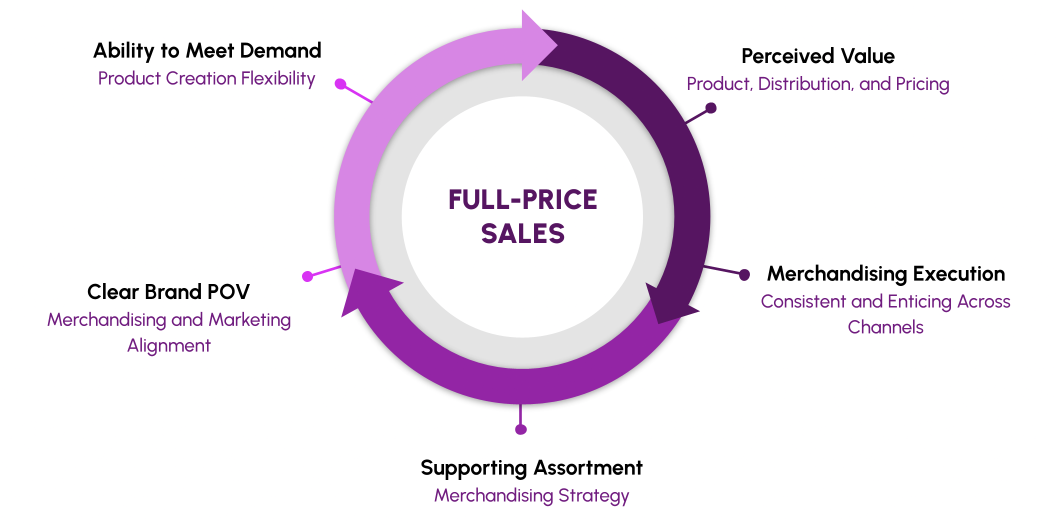
1 – Perceived Value. What you sell, where you sell it, and at what price all have to align with what the customer thinks the product is worth. Durability, longevity, quality materials, and sound construction are the foundation. Without those, there is no full-price sale. Ralph Lauren blows it out of the water here. When they over-distributed into department stores and off-price, the product didn’t change but the perceived value did. So they pulled back.
2 – Merchandising Execution. How the product is presented has to be consistent. If the floor looks like a flea market, the customer will always hunt for a bargain (although I do like visiting a good and proper flea market.) The point is that premium price points require premium standards.
3 – Supporting Assortment. One-off products don’t make an assortment. A bestseller creates a halo effect, and the customer wants more than one item. Merchandising strategy is a curation of options that build outfits around the hero.
4 – Clear Brand POV. Merchandising and marketing have to agree on how the assortment gets executed in season, in stores, and with wholesale partners. If the brand is elevated, that has to hold everywhere the customer meets it. An unkempt retailer becomes the customer’s read on the brand.
5 – Ability to Meet Demand. Demand only converts if the supply chain is flexible and the product creation process can react. If a product resonates and you can’t chase it, the customer goes elsewhere. Process innovation is the method of choice here.
Start Spinning the Wheel
Starting the flywheel can be daunting so here are three suggestions on what to do to premium-ize your offering:
1 – Start with your product. Audit your current assortment across all your channels, including your wholesale partners. Identify what sells at full-price, what waits for a discount to move, and what doesn’t sell at all. Look for patterns and disconnects between all channels.
2 – Clean up how your product shows up. Merchandising execution is the first thing the customer sees. Walk your own stores and your retail partners’ stores. Shop your ecom site the way your customer would. Look for inconsistent presentation, a cluttered assortment, and outfits that are hard to spot.
3 – Build the assortment around a hero, not a pile of singles. The fastest path to full-price sell-through is a bestseller with a supporting cast. Identify your strongest products and build around them. Complement them so they read as outfits.
Selling at full price isn’t a given because you say so. Commanding the price point is earned, and that means putting in the work.
Holding it takes even more, because it doesn’t take much to slip back into the discounting habit and squandering hard earned brand equity.