A Surprising Share of Fit Trouble is an Inside Job.
GLP-1s are real, but no matter what the headlines suggest, they are not the most powerful factor at play.
The bigger force magnifying Fit VolatilityTM lives within the four walls of your favorite retailer or brand.
The apparel supply chain is already one of the longest and most complex. Planning often amounts to guesswork, and overdevelopment is rampant. Time to market already exceeds 52 weeks, and at some well-known brands dysfunction is pushing that number up, not down.
Under Armour CEO Kevin Plank put it plainly on a recent earnings call: “For too long, the organization carried unnecessary complexity. Too many handoffs, too many approvals. Too much focus on one’s individual job, versus a broader brand objective we’re trying to solve for.”
An organization’s internal dynamics and processes are a significant contributor to Fit Volatility. When they are dysfunctional, fixing them is a precondition for solving any fit problem. That dysfunction also propagates upstream through the supply chain to the garment factories and textile mills.
I mean, do we really need five prototypes to “get it right?”
The Fit Volatility Index
With that in mind, I thought carefully about everything that drives Fit Volatility.
It is not only about the customer, but also about product creation processes. GLP-1s and other external factors are omnipresent, but so are the consequences of low-cost sourcing.
So I present the Fit Volatility Index, shown in the diagram below.
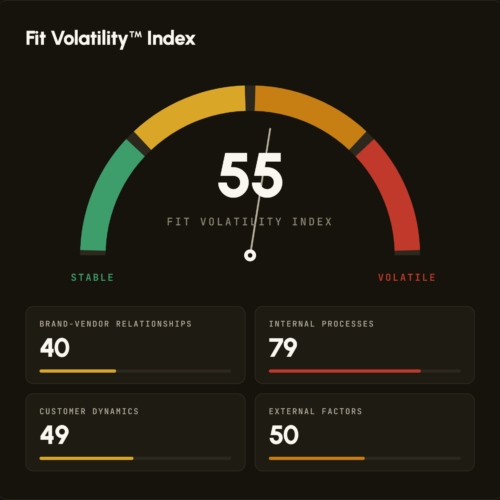
It accounts for the four major categories that influence Fit Volatility. Let’s run through them quickly and define what each one considers.
1 – Brand/Vendor Relationships. To what extent are these relationships adversarial and cost-driven? Recent Sourcing Journal reporting shows brands pay 30 percent less in real terms for a cotton T-shirt than they did 25 years ago, with the cost absorbed by garment suppliers in Bangladesh. Or are vendors true partners with some level of shared risk and interdependence? Cost-driven relationships cannot reduce Fit Volatility. Partnerships can.
2 – Internal Processes and Systems. Our definition of Fit Volatility rests on the failure of existing product development processes to evolve. Insights are routinely held hostage by marketing and reach the product development team late, if at all. Are deadlines in the product creation process being met? And a question underneath all of it: are fit blocks and size curves becoming unmoored from the bodies they were built to fit. Does the timeline for updating them match the rate of the customer’s body composition change?
3 – Customer Dynamics. Does the brand clearly understand its ideal buyer and evolve with them, or better yet, ahead of them? Does it see the adjacent opportunities surrounding that buyer? Consider an aging population that keeps growing while birth rates fall, retirement is being redefined and demographics of skilled labor workforces are changing.
4 – External Factors. Can the brand gauge the impact of external forces like weather events, GLP-1 weight loss and rebound rates, sudden wealth from IPOs, and immigration and emigration trends? Even better, can the brand anticipate these events and have a robust enough system in place to absorb the impact of said factors?
For the sake of simplicity, each factor is weighted equally, and the final score is the average of the four. That is admittedly arbitrary: the absolute value of the index matters less than the relative scores.
Presenting it this way makes a critical point: if internal processes are out of control, the index score can stay moderate or high even when the brand has a firm grasp on the customer dynamic.
More customer information, however valuable, means nothing if it cannot be deployed fast enough to keep pace with changes in body composition. Take all the body scans you want, or join a new global size study from Hohenstein: none of it matters if the information goes off to die in a spreadsheet.
So what do you think your index number is?