Winning brands can tell you exactly who their ideal buyer is.
Other brands can tell you who their ideal buyer WAS.
Although it might sound good, those other brands might be describing the buyer from a customer profile or deck that was written years ago, not the one walking past the window today.
Club Monaco, for instance, is speaking in the past tense. And it has been costing them. You can measure the cost in closed flagships and empty windows.
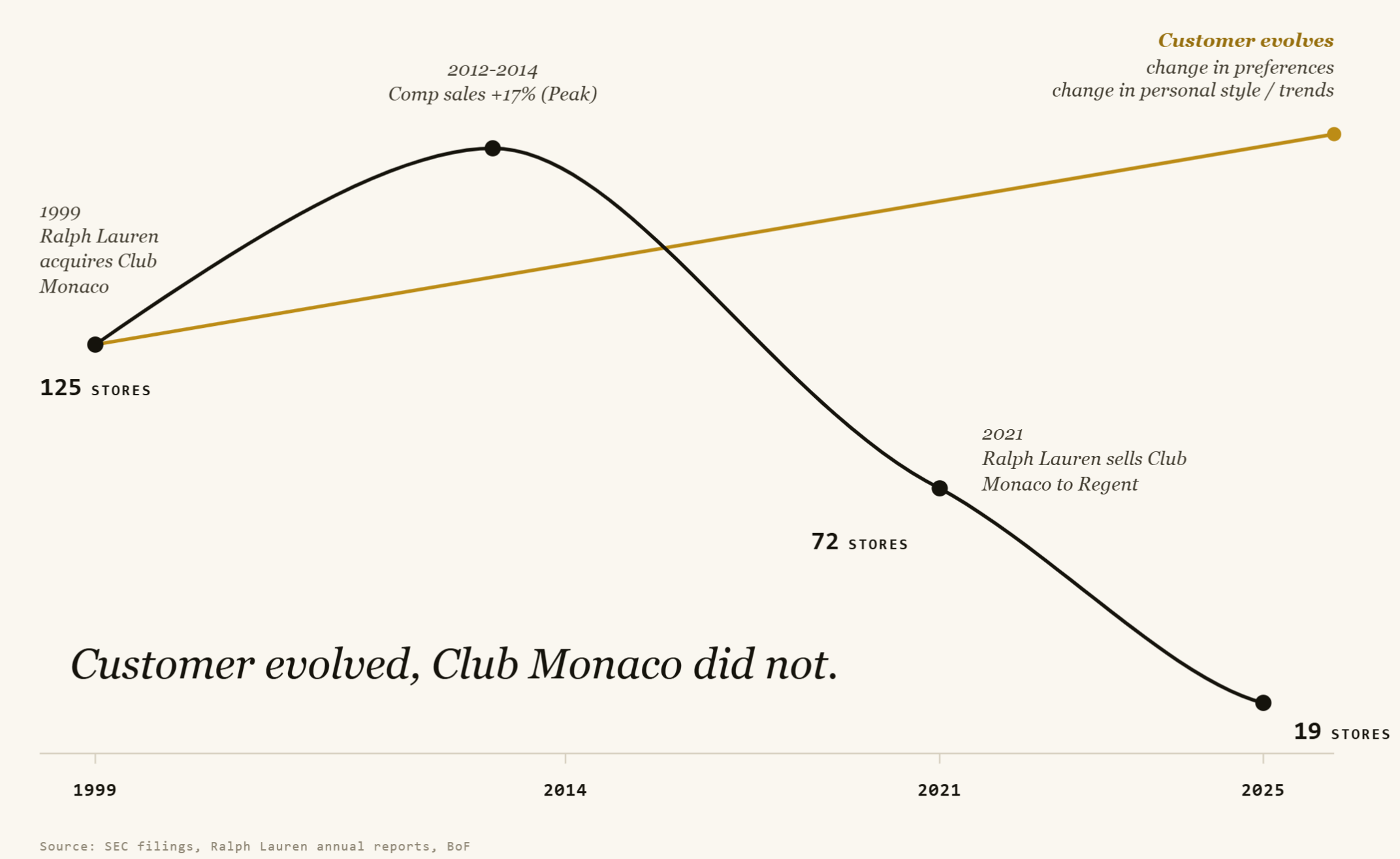
Ralph Lauren acquired Club Monaco in 1999 at 125 stores. Comps peaked at +17% in 2012-2014. Ralph Lauren sold the brand to Regent in 2021 at 72 stores. Today it is roughly 19.
The store count is only half the chart. The other half is the customer, who kept evolving the entire time. Preferences shifted. Personal style shifted. The two lines crossed, and the brand stayed where it was.
The customer evolved and left the brand behind.
The Buyer Changed
In 2014 the buyer was the aspirational creative-class woman. Late 20s to mid-40s, urban professional, reading Vogue and InStyle, saving up for cashmere, trusting brands to curate for her, leaning on in-store stylists, shopping with friends after brunch.
In 2026 she is the post-pandemic, post-GLP-1 wardrobe builder. She works hybrid. Her body is changing and self-care is non-negotiable. She researches before she buys, values price-to-quality, and earns loyalty per purchase, not per brand. She does not wait to be curated to. She builds her own style off social media.
That last shift is the one most brands underrate. A changing body is a fit and assortment problem, not a campaign problem. The buyer who used to trust the brand to edit for her now edits for herself.
Club Monaco Didn’t
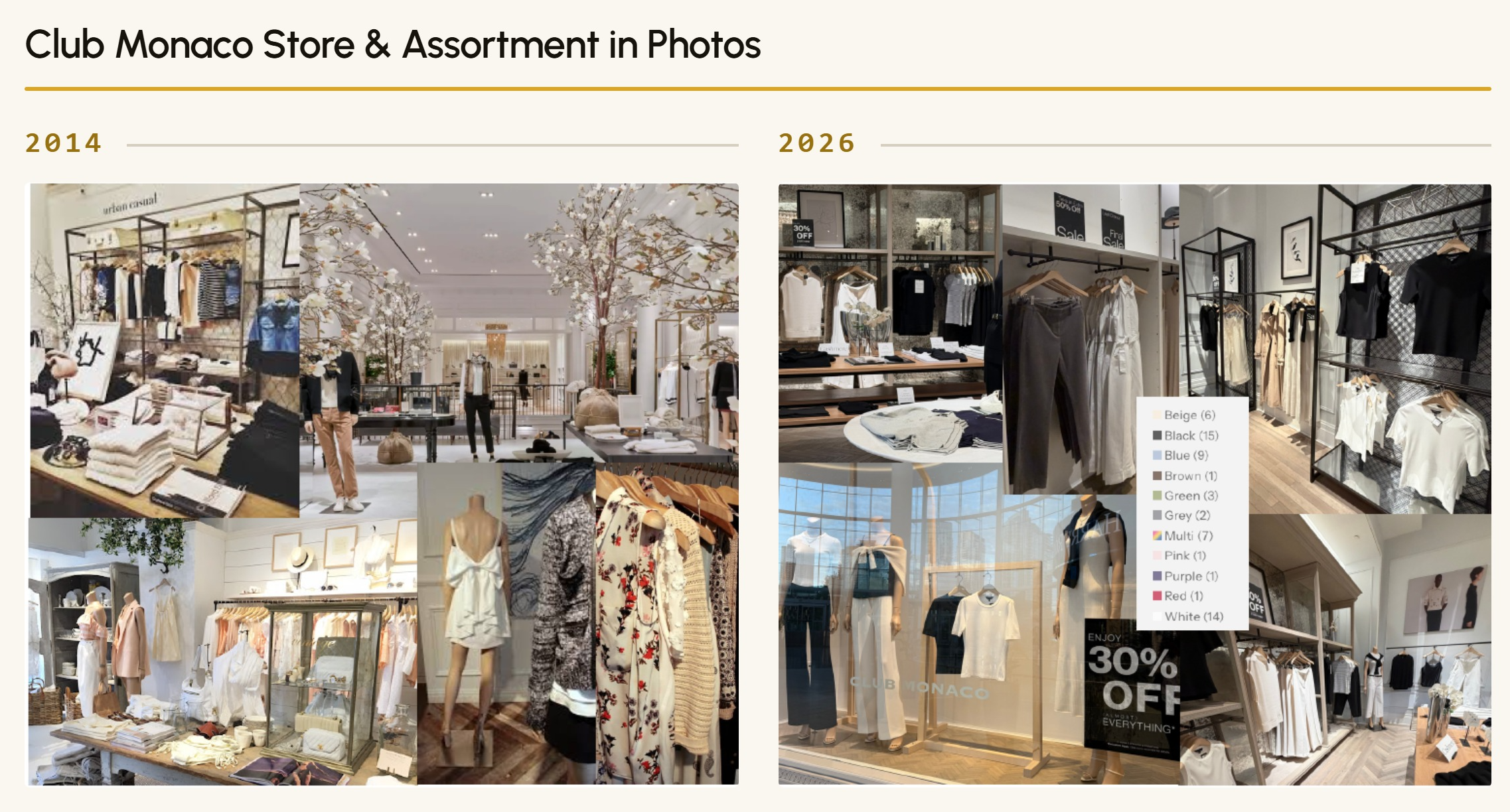
In 2014 the assortment was curated, considered, cool by association. Italian wool, cashmere, tailored trousers with real fabric stories, third-party brands woven in, capsules that read like a well-edited closet. The brand coined accessible luxury and earned the price.
In 2026 the assortment is generic, undifferentiated, unclear. Basics that do not beat Quince on price. Trend pieces that do not beat Zara on speed (and processes that can’t compare to either Quince or Zara.) Tailoring that does not beat Aritzia on fit.
The online range is 59 styles. The color story collapses to black and white, with everything else in single digits.
The Store Is Frozen In Time
The 2014 store was a destination. Flagships on Bloor, Fifth Avenue, and Prince Street with flower shops and cafes, programming during TIFF and the fashion weeks, designed for lingering. Call it third space before that was the term. The store was the brand’s editorial voice.
Today the flower shops and cafes are gone. The flagships closed or downsized into something that reads like any other mall specialty store. The experiential layer that defined the brand does not exist, and the windows give the customer no reason to walk in.
A New Playing Field
The 2014 peer set was J.Crew, Theory, Banana Republic, Madewell, COS, Reiss. Elevated specialty retail. Same model, competing on taste.
The brands taking that customer now are Aritzia, Reformation, Quince, Sezane, Alo, Frame.
It’s a different game today. Vertical, viral, values-led, customer-obsessed. Competing on taste against a field that is now playing a brand new game is destined to fail.
Club Monaco Is One Of Many.
Club Monaco is the case study, but the failure is generic. The brand kept serving a buyer who had moved on.
Any brand can fall into the same trap, because the profile, although outdated, still describes someone real.
As such, we suggest that brands and retailers run the ideal buyer diagnostic:
- Is your ideal buyer the same today as a few years ago?
- Are you moving with them, or projecting for the buyer you presume still exists?
- Who will they be in one year? In five?
- Get out and comp shop. What are the winning brands doing today that you are not?
Club Monaco is losing stores and customers.
You don’t have to.